

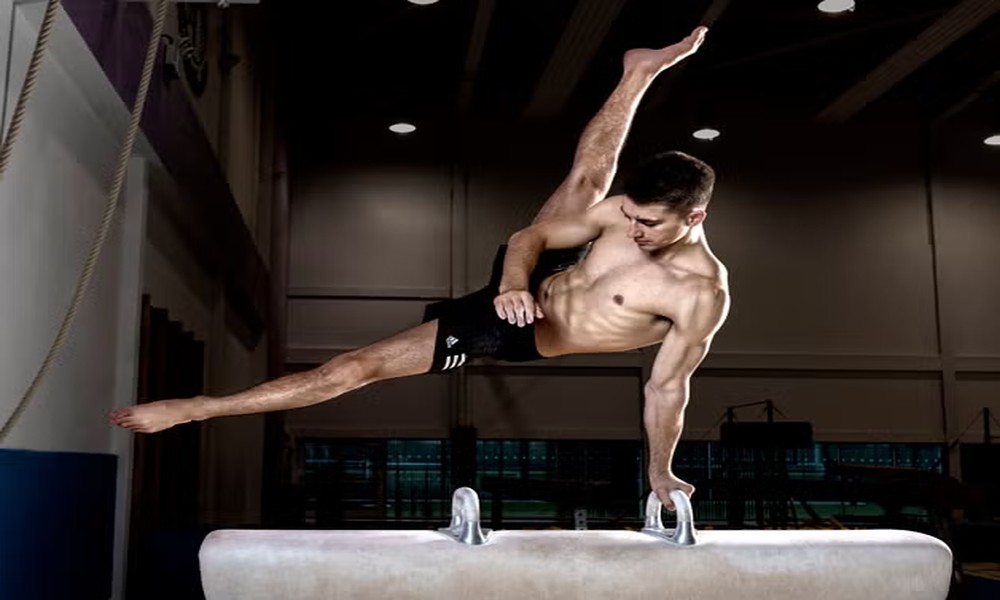
Yes, you can build a gymnast physique without gymnastics-through high-tension calisthenics and strategic fat loss. The distinctive look-lean, muscular, with exceptional upper body development-is achievable for adults in 12-24 months with consistent training and proper nutrition.
The full training methodology for achieving gymnast-level physical development as an adult is explained in this gymnast physique training guide, which covers the muscle growth science behind calisthenics-based development.
What Makes a Gymnast Physique Distinctive
Gymnasts develop specific physical characteristics through their training that distinguish their physiques from conventional gym physiques:
- Exceptional relative upper body strength – pulling and pushing strength relative to bodyweight
- Highly developed upper back, lats, and rear deltoids from constant pulling and support work
- Thick, well-developed chest without excessive mass that disrupts proportions
- Developed arms – biceps and triceps – from constant bodyweight loading
- Lean midsection with visible abdominal definition and natural waist taper
- Proportional lower body without excessive leg mass
The key differentiator is the ratio of upper body development to overall body size, combined with low body fat. This creates a visual impression of power and athleticism rather than simply size. The most striking characteristic is the shoulder-to-waist ratio – gymnasts develop broad shoulders without proportional lower body mass, creating an inverted triangle silhouette that barbell training rarely produces. This is partly mechanical: calisthenics-based training emphasizes upper body pulling and suspension work far more than lower body development, naturally preserving this ratio.
The Training Principle Behind Gymnast Muscle Development
Gymnasts develop their physiques primarily through high-tension calisthenics – bodyweight movements performed with extreme control, at high relative intensity, through full ranges of motion. The key mechanisms differ subtly from conventional resistance training.
Gymnastic movements require isometric strength at multiple joint angles simultaneously. The front lever, for example, demands maximal tension from the lats, core, and arms simultaneously while maintaining a fixed position. This type of loading produces a specific muscle development stimulus – particularly for the stabilising fibres within each muscle – that differs from the concentric-eccentric loading of conventional weight training.
The result is muscles that are both visible and functional – not inflated with volume but genuinely dense and capable. The physiological mechanism behind this involves time under tension at extreme leverage disadvantages. When you perform a weighted pull-up at bodyweight-plus-load, the muscle contracts and relaxes cyclically. When you hold a front lever position, every muscle fibre involved is recruited simultaneously to prevent movement. This recruitment pattern activates different motor unit populations and creates sustained metabolic stress in stabilizer muscles, leading to hypertrophy without the joint stress of heavy barbell movements.
The Core Movements That Drive Gymnast Physique Development
Pulling Movements
The gymnast physique is built on pulling strength. Weighted pull-ups, archer pull-ups, and front lever progressions develop the lats, biceps, and upper back that characterise gymnastic upper bodies. These should form the foundation of any programme targeting gymnastic aesthetics. The lats are particularly critical – they create the width at the shoulders that’s distinctive to the gymnast aesthetic. Progressions matter here: begin with strict pull-ups for 5-8 reps, then add weight in small increments (2.5-5 lbs) once you can hit 8+ reps with perfect form. Archer pull-ups introduce single-arm tension that’s harder to achieve with bilateral movements, forcing greater lat recruitment. Front lever work is the apex of lat development – even partial progressions like tuck front levers will develop the lats more intensely than any other movement.
Pushing Movements
Ring push-ups, dips, and planche progressions develop the chest and triceps under higher instability and control requirements than barbell pressing. The rings add a stabilisation demand that increases muscular activation across the chest and shoulder girdle. Dips specifically target the lower and outer chest while building tricep mass, creating the chest shape that pairs well with the narrow waist characteristic of the gymnast look. Ring push-ups are superior to barbell bench press for gymnast aesthetics because they allow greater scapular freedom and create deeper chest activation. Planche progressions – from wall-assisted holds to freestanding planches – develop the chest and anterior deltoids through extreme leverage disadvantage, producing dramatic chest development without the mass-building stimulus of barbell work.
Core and Compression Work
L-sits, tuck holds, and hollow body positions develop the abdominal and hip flexor strength that keeps gymnasts’ midsections tight and functional. These movements build deep core stability alongside visible abdominal definition. Unlike crunches or machine work, these isometric positions demand co-contraction of the entire core musculature – rectus abdominis, transverse abdominis, obliques, and spinal erectors all work together. This creates both visual definition and the “tight” appearance around the midsection. L-sit progressions should progress systematically: start with bent knees or single-leg extension, building hold time from 10-15 seconds toward 30+ seconds, then progress to full L-sits and eventually V-sits.
Shoulder Stability Work
Handstand work – even partial progressions – develops the rear deltoids, rotator cuff, and scapular stabilisers that give gymnastic physiques their distinctive shoulder development. This shoulder girdle development is one of the hardest things to replicate with conventional weight training alone. Wall-supported handstands, handstand holds, and handstand shoulder taps develop the stabiliser muscles that create the “3D” shoulder appearance. The rear deltoids are particularly important for the gymnast look, and handstand work trains them through extreme ranges unavailable in barbell training. Even 5-10 minutes weekly of handstand practice produces noticeable shoulder development within 3-4 months.
The Fat Loss Component
The gymnast physique depends on low body fat as much as muscle development. Elite gymnasts typically maintain 5-10% body fat year-round. For non-gymnasts pursuing the aesthetic, 10-14% body fat is the range where the physique characteristics become visually apparent.
Getting to this level of leanness requires the same hormonal understanding as any lower abdominal fat loss – specifically managing the alpha-2 receptor-rich fat in the lower abdomen and flanks that resists standard caloric deficit approaches. The distribution of fat loss is governed by receptor density: lower abdominal and flank fat has higher alpha-2 adrenergic receptor density, meaning it mobilizes more slowly during caloric deficits. Achieving visible abdominal definition requires either extended deficits or strategic approaches that improve blood flow to these regions during training (high-rep work, conditioning, or targeted supplementation). The visual appearance of the gymnast physique dramatically shifts at different body fat levels – at 18-20%, muscle definition is minimal; at 14-15%, abdominal definition appears; at 10-12%, the upper back definition and inter-muscular separation become striking.
Nutrition and Body Composition Strategy
Building the gymnast physique requires parallel progress on two fronts: gaining muscle through calisthenics training and reducing body fat through nutritional management. The training stimulus is only half the equation. Protein intake should remain elevated (0.8-1g per pound of bodyweight) throughout both muscle-building and fat-loss phases. During muscle-building phases, a modest caloric surplus (200-300 calories above maintenance) supports training recovery and progression. During fat-loss phases, a conservative deficit (300-500 calories below maintenance) preserves muscle while reducing body fat. The rate of progress matters: aiming for 0.5-1 lb of fat loss per week is sustainable and preserves training performance. Faster deficits often coincide with reduced training output and muscle loss.
A Realistic Adult Timeline
An adult male starting from reasonable fitness (some training background, 15-20% body fat) can achieve recognisable gymnast physique characteristics in 12-24 months with consistent, progressive calisthenics training and appropriate fat loss nutrition. The specific timeline depends on starting strength levels, body fat reduction required, and training consistency.
Within the first 3 months, noticeable upper back and shoulder development should be apparent, and initial strength gains in key movements (pull-ups, dips, handstands) should be measurable. By 6 months, the ratio of upper body development to overall frame becomes visually distinctive. At 12 months, assuming proper programming and nutrition, the physique characteristics that define gymnast aesthetics – upper back width, shoulder definition, visible abdominal separation, and proportional development – become recognizable. The final 6-12 months involves dialing in body fat percentage and refining details like shoulder girdle symmetry and lat shape through variation in pulling angles.
The physique characteristics that make gymnastics aesthetics distinctive – the upper back development, the shoulder-to-waist ratio, the functional leanness – are achievable. They require the right training modalities and the right approach to body composition, but they are not age-gated or experience-gated beyond basic physical capability.
Frequently Asked Questions
Can you build a gymnast physique without doing gymnastics?
Yes. The specific characteristics of a gymnast physique-upper back width, shoulder development, low body fat-come from high-tension calisthenics and proper nutrition, not from gymnastics itself. Most adult males can achieve recognizable gymnast aesthetics in 12-24 months through progressive calisthenics training.
What’s the fastest way to get a gymnast physique?
Combine progressive calisthenics (pull-ups, dips, handstand work, L-sits) with consistent fat loss nutrition. The upper back and shoulder development typically appears within 3-6 months of dedicated training, but reaching full gymnast physique definition (10-14% body fat with visible muscle separation) takes 12-24 months.
Do you need to be young to build a gymnast physique?
No. Age doesn’t prevent the development of calisthenic strength or muscle definition in adults. Recovery and progression may take slightly longer for older trainees, but the underlying mechanics of muscle growth and fat loss remain the same across age groups.
How important is body fat percentage for the gymnast look?
Critical. Body fat percentage determines visual definition more than muscle size. Elite gymnasts maintain 5-10% body fat year-round; for adults pursuing the look, 10-14% body fat is the range where the distinctive physique characteristics become visually apparent.
